Back to top
Referentiality
As I have argued in
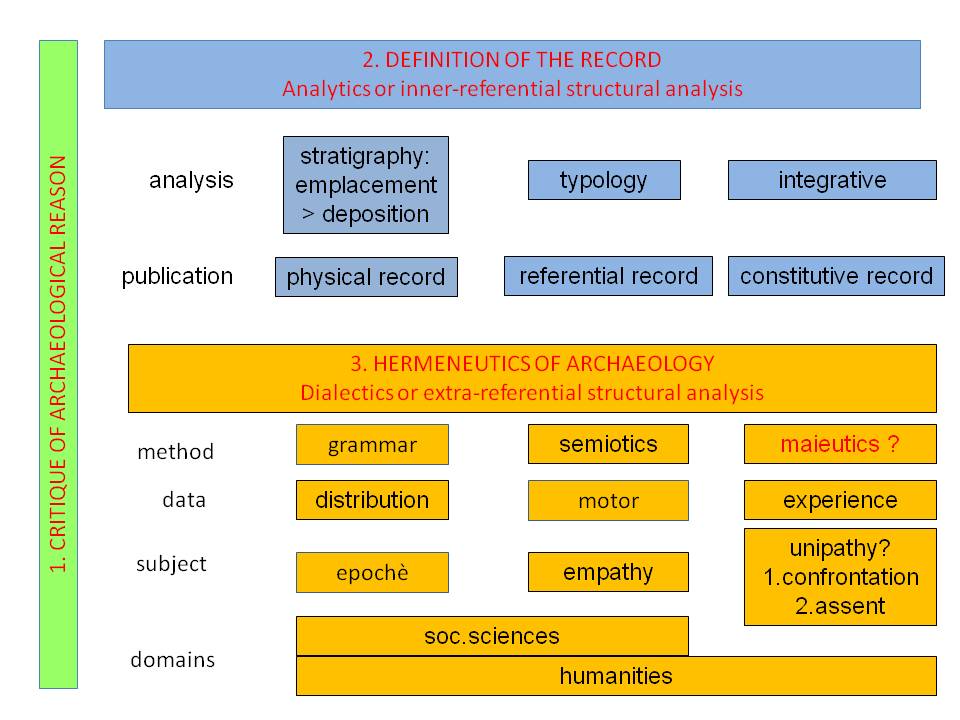
The interconnection between critique and hermeneutics may be viewed in terms of the way in which they relate to referentiality (see Notes, 15.7-15.8).
The critique focuses on the inner dimension of a system. Accordingly, it views the system as rigorously auto-referential, with an emphasis on its structural make-up. It is closed to the outside not because it denies the existence of an external dimension, or the possibility of relating to it, but because the effectiveness of the analysis is proportional to the way in which levels of analysis are kept separate. It is for this reason that I stress the primary importance of defining archaeology for what it does exclusively: rather than just a question of semantics, it is a question of posing the boundaries within which the referential range of the system can be understood and analyzed.
Hermeneutics, on the other hand, focuses on the extra-referential dimension of a system. Alternatively, we may say that the boundaries are broadened so as to define a wider system, one that subsumes, under the nodes of an inverted conceptual tree, other systems to which a critical approach has already been applied.
Back to top
Critique
the ore-linguistic dimension
Archaeological reason may thus be understood .
It is evidenced in the first place by the observation of the emplacement of elements exposed during excavation, and by the inferential reconstruction of deposition. It is the moment when the "breakage" is most dramatic, most apparent and most definitive.
Back to top
Hermeneutics
Here, archaeological reason describes the observer's relationship to specific cultural environments to which no one any more natively belongs. The carriers of that culture did, indeed, share a common "space," and it is into this space that we aim be "inducted" again. The hermeneutic aim is to reconstruct the common space they shared so that we may be able to share it again, healing the brokenness, on the basis of the more universal condition of human cultural experience.
the seminar as example
Foucault, but starting from archaeology
Back to top
Grammar and truth
Back to top
The import for philosophy as a whole
Kant > Heidegger/Gadamer/Derrida/Foucault
Back to top
References
|